Here is what almost no local business owner has noticed in the last eighteen months. Their Google ranking is fine. Their reviews are fine. Their website still loads when somebody types their name. Ask an AI assistant — ChatGPT, Perplexity, Google AI Overviews — for a recommendation in their city, and they are not named. Their competitor is.
They have been quietly dropping out of the place where new customers actually decide. AEO Prospector Pro is the tool that shows you exactly who's vanished — and hands you the words to close them.
This page is the news. And the scene. Let me show you what it actually looks like.
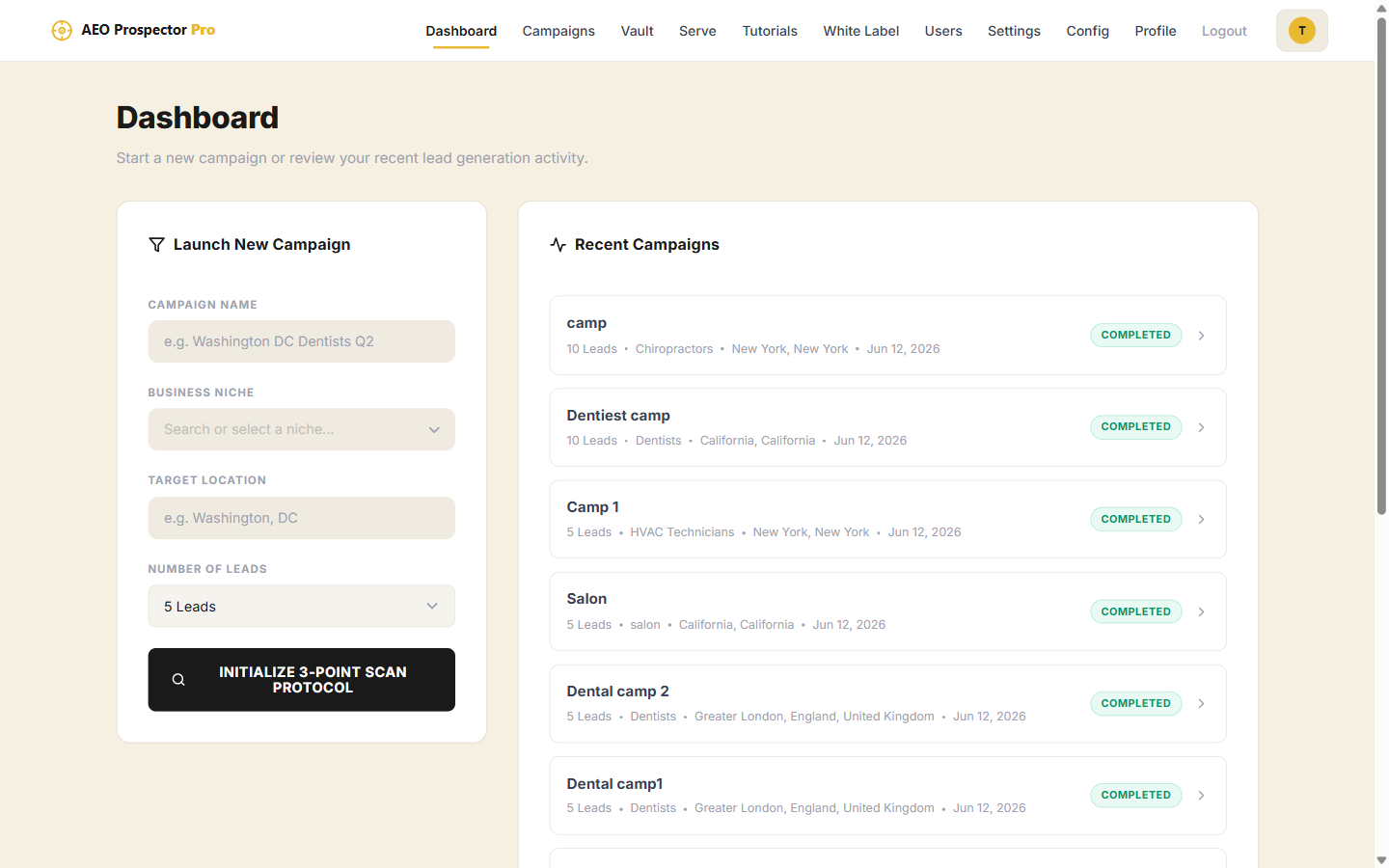
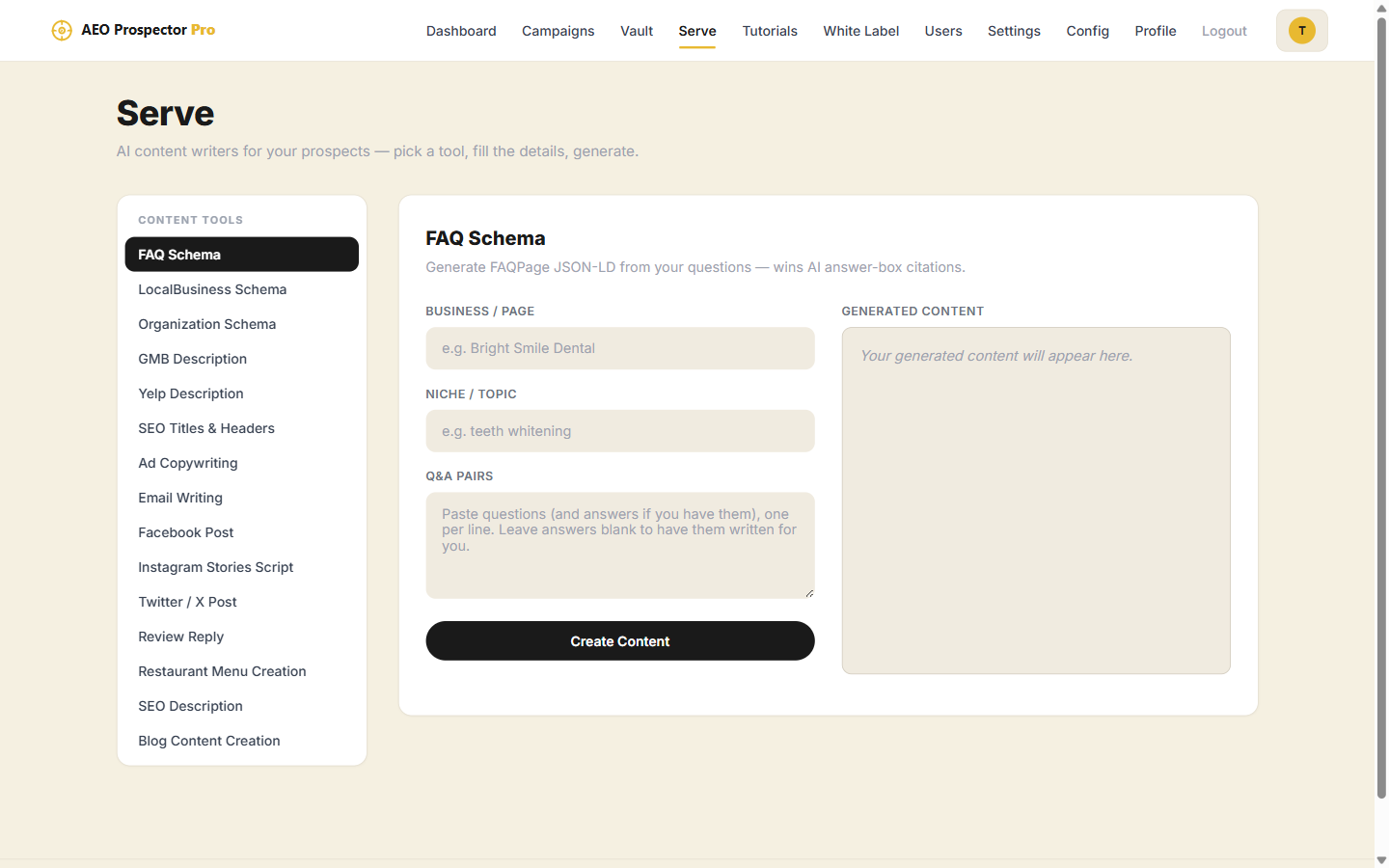
The actual app · Launch a scan in three fields
Search did a quiet thing recently. It stopped being about results and started being about answers.
Twenty years of local marketing was built on the assumption that a customer types a query, scans ten links, picks one. Local SEO worked. Reviews worked. Photos worked. Ranking #1 on "[niche] near me" basically meant the phone rang.
Then a switch flipped underneath everyone. In the last eighteen months, more and more customers stopped typing — and started asking. They opened ChatGPT. They tapped Google's AI Overview. They asked Perplexity. Same intent. Different mechanism. Almost nobody on the local side noticed.
The underlying layer that decides who gets recommended in those answers has different rules. It doesn't care about your meta description. It doesn't care if you outrank someone on Google. It cares about three specific signals — structured data, content the AI can parse as answers, and whether your business is registered as an entity in its training and retrieval — and most local businesses have none of them.
The result is a quiet, ongoing disappearance. Roughly 40–60% of local businesses in any given city are now invisible in the answer layer. Their Google ranking is still fine. Their reviews still come in. They're just not named anymore when the question gets asked the new way.
And here's the part the early movers have figured out. The agency that runs this diagnostic first — in any niche, in any city — owns that niche for the next decade. Because the prospect list isn't theoretical. It isn't a guess. It's a hard, scored, verified list of businesses that are actively losing customers right this minute, with a specific reason and a specific fix.
The wedge writes itself. The pitch writes itself. The only thing that doesn't write itself is who's on the list — and that's what this app is.
Let me get specific. Right now, somewhere in your prospect's city, a customer is opening ChatGPT and typing one of about a hundred different phrasings of the same question. "Best plumber near me." "Who should I see for a sore back." "Where do I get my windows cleaned." The AI is answering — and the answer is always small.
That's the new front page of the internet for local commerce. Three names. Your prospect's business is either in the answer or it isn't. They have no idea the conversation is happening. They aren't watching. They aren't competing. They were never told there was a new game to play.
Now multiply that single moment by every customer in every city in every niche. Every minute. That is the conversation AEO Prospector Pro plugs you into.
A business doesn't just "drop out" of the answer for mysterious reasons. There are three specific structural failures that decide whether an AI assistant names them or doesn't. AEO Prospector Pro runs all three, on every prospect in your city, in roughly the time it takes to make coffee.
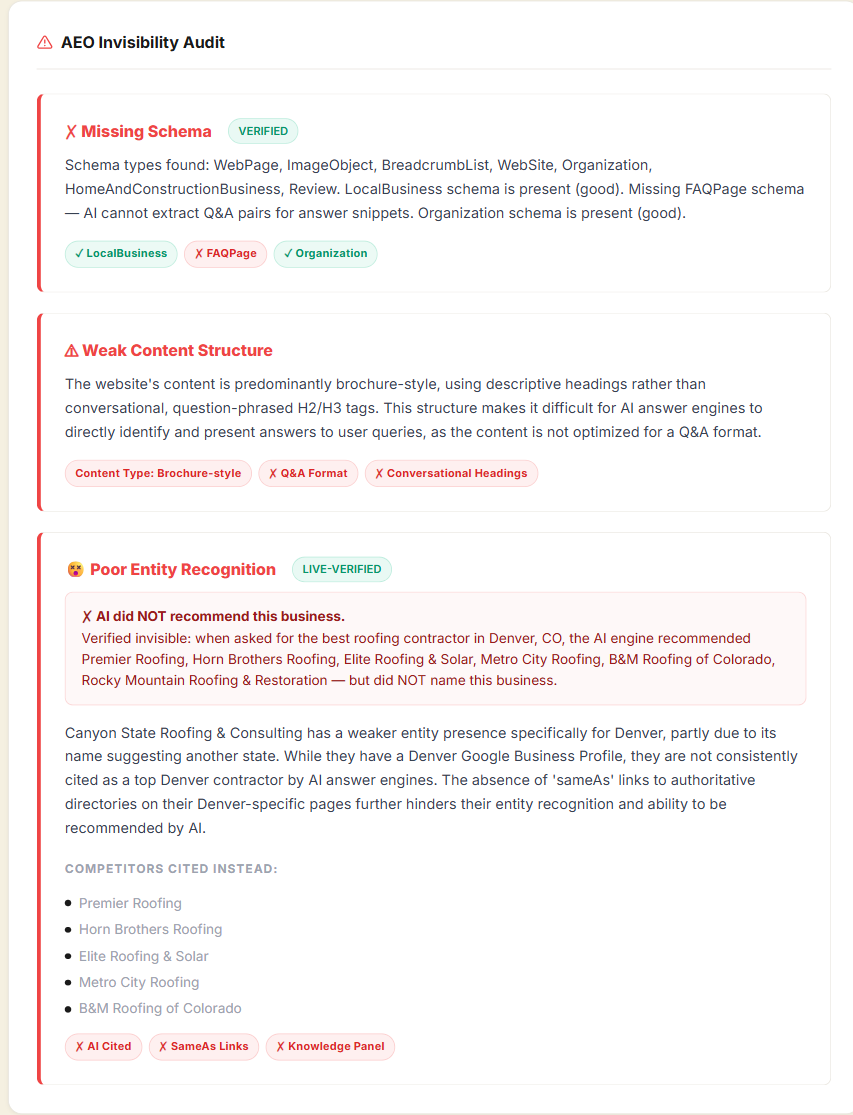
Live-scrapes the site for the structured-data tags AI retrieval depends on — LocalBusiness, FAQ, Organization JSON-LD. If the markup isn't there, the AI doesn't know what the business is, who it serves, or where it operates.
Checks the content structure. AI assistants prefer Q&A-shaped content they can pull a clean answer from. A 1998 brochure-style site full of "we're the best" claims gets passed over for a competitor whose page actually answers a question.
The live check. Actually asks an AI assistant "best {niche} in {city}" in real time and records whether the business is named — and which competitors win the slot instead. This is the gotcha. This is the receipt.
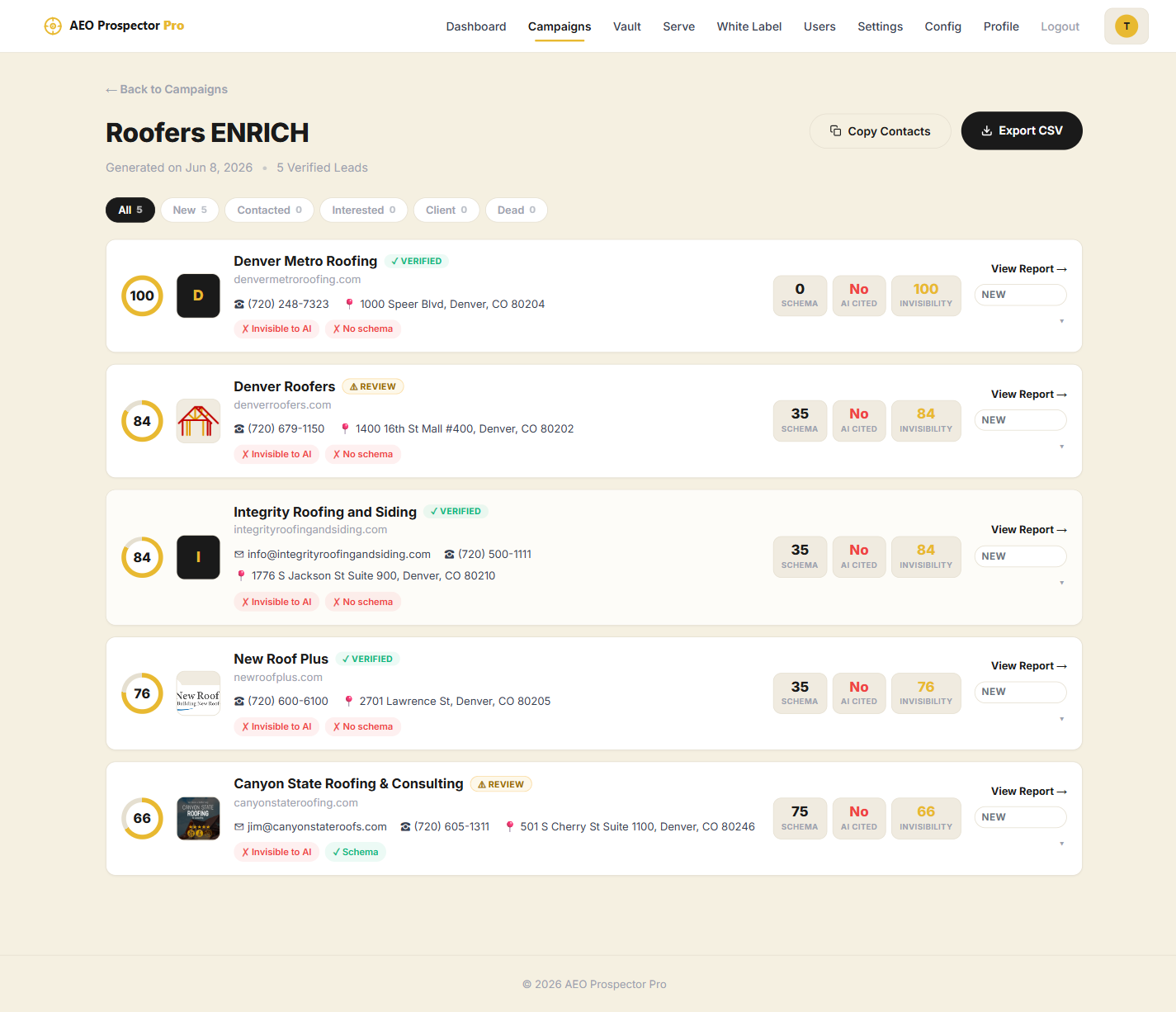
All three pillars, per lead — including the live "AI did NOT recommend this business" receipt
When a business fails all three, they don't show up. When they fail two, they show up sometimes. When they pass all three, they're competing. Most local businesses fail two or three — and have no idea. That's the prospect list.
Most scraping tools ship junk. Dead domains. Parked pages. info@ guesses. A lead list with 30% noise is worse than no list — because you spend your good outreach time on prospects that never existed. AEO Prospector Pro drops the junk before it ever reaches you.
Domains that no longer resolve, parked pages, "for sale" landers, and wrong-business redirects are filtered out before the lead lands in your pipeline. You only ever see a business that is actually open and reachable.
Emails are domain-matched and MX-validated against the live mail server. Every email comes with a provenance badge — "found in structured data," "found on contact page," "verified via mail server" — so you know what you're sending to.
info@If we can't find a real, verifiable email for a business, the field stays blank. We never invent a contact. Blank is better than fake — and your sender reputation will thank you.
Every lead carries a numerical confidence score so you can sort by highest signal. The tightest leads — confirmed business, verified email, failed all three pillars — go to the top of your call list automatically.
Every lead live-verified · Invisibility score, real email & pipeline stage, built in
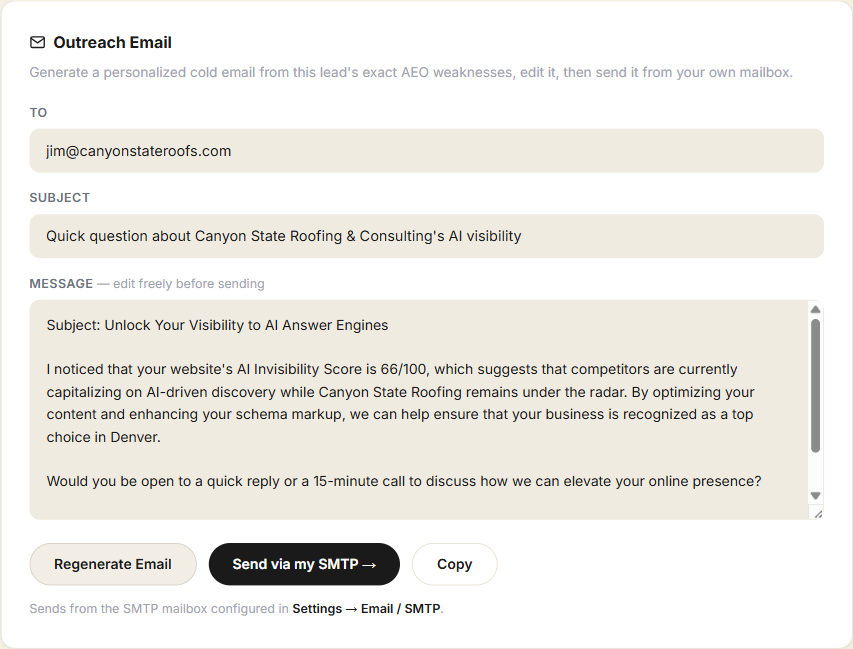
The hardest part of any outbound campaign is the first sentence — the one that proves you bothered to look at the prospect. AEO Prospector Pro writes it for you, on every lead, personalized to the exact invisibility weaknesses the diagnostic surfaced. The audit IS the email. The email IS the pitch.
Hi Dr. Chen,
Quick note about something most local practices haven't noticed yet. I ran a check on Star Dental Practice this morning and three things stood out.
First — when I asked ChatGPT "best dentist in Austin", three practices came back. Star Dental wasn't one of them.
Second — the site is missing the structured data (LocalBusiness JSON-LD) that AI assistants use to know who you are and where you operate. AI literally can't read you.
Third — your nearest competitor passes all three checks. They get named. You don't.
None of this shows up in Google. Your ranking and reviews are great. But it's quietly costing you the new-patient calls that now start with "ChatGPT, who should I see."
Fixable in a couple of weeks. Worth a 15-minute call?
— [Your Name]
[Your Company] · [Phone]
Every lead gets one of these. Personalized. Specific. Sent the moment you click. The reasoning is in the email — so the prospect can't dismiss it as a template, because no template would know the three things this one knows.
Generated, editable, and sent from your own mailbox — one click
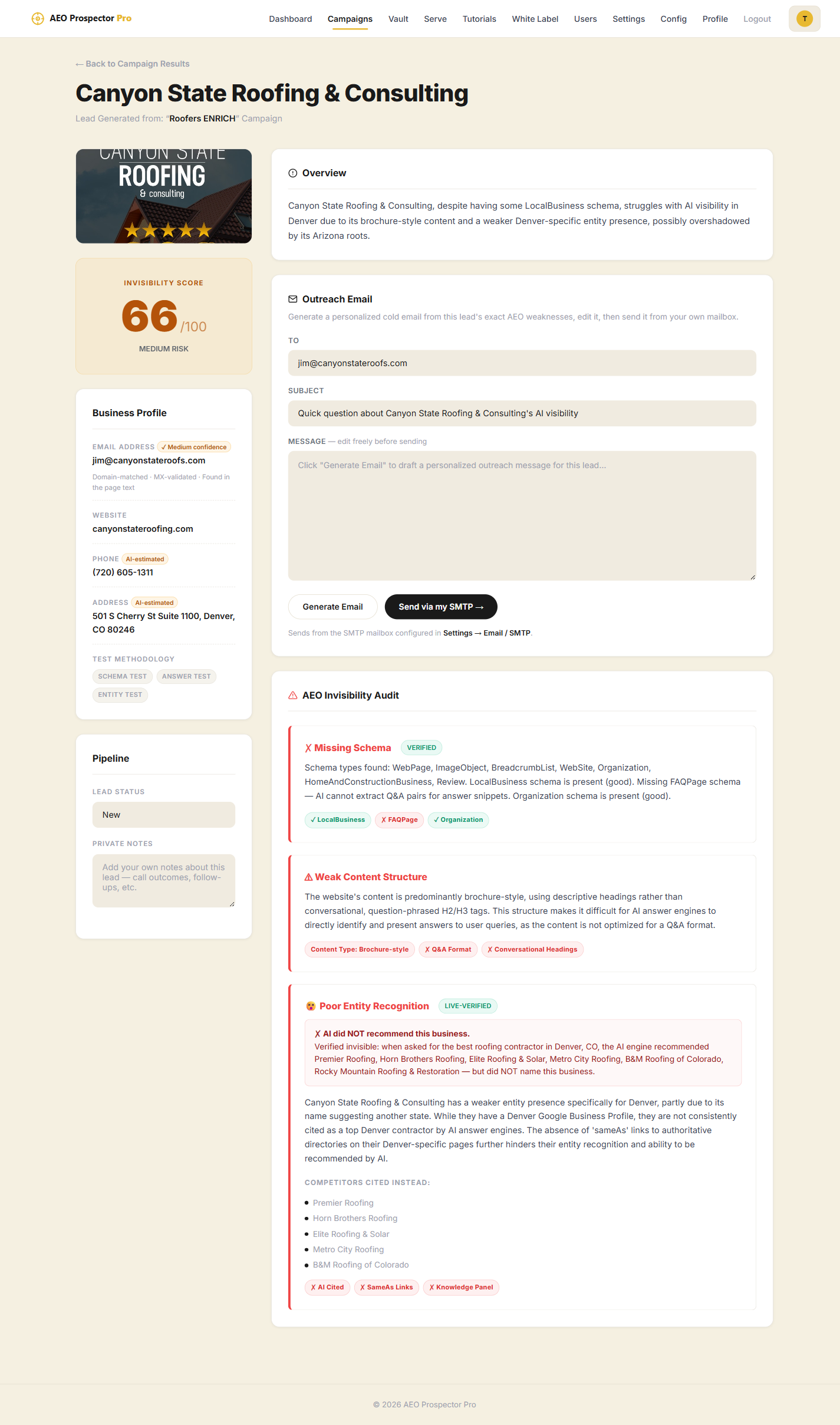
The cold email lands. The prospect clicks the link. They land on a hosted public page with their own business at the top, graded against the three pillars in real time, with the three competitors who ARE being named in AI answers listed underneath. The report does the selling. The owner spends four minutes reading it. They forward it to their partner. They reply asking what it costs to fix.
The report sits at a public URL. Mobile-responsive. Shareable. Real numbers, real competitor names, real recommendations — generated in nine seconds per business. Owners read it twice on their phones. This is what turns the audit into the pitch.
The real report — score, business profile, three-pillar verdict, all on one page
Everything you just read — the scan, the three-pillar diagnostic, the one-click pitch, the report a prospect opens — running live, start to finish. Three fields in. A closeable lead out.
The full run — scan to closeable lead, no edits, no cuts
AEO retainers price higher than legacy SEO because the category is new and most agencies haven't priced it yet. You're getting in first, which means you set the number. Here are illustrative figures a working operator could reasonably charge for fixing what the three-pillar diagnostic surfaces. Conservative end of the range.
Close two and the math doubles. Close ten in a year and you're running a real local agency on a $88 software stack. The diagnostic is doing the heavy lifting before you ever pick up a phone — every closed client is funded by the math above many times over.
The early operators on a new layer always win the most. The customer asking an AI for a recommendation is brand-new behavior at scale. Whoever runs the diagnostic in a niche first owns the niche. Here's the kind of operator who tends to be that first mover.
Add AEO and AI-visibility as a service line on top of what you already sell. Same client, new deliverable, fresh recurring revenue — without learning a new niche.
The natural pivot. Your skill set transfers almost completely — schema, content structure, entity optimization. The only difference is which question you're answering: "rank in Google" becomes "appear in the answer."
Every site you build is now a candidate for AEO upgrade — and an excuse to go back to old clients with a brand-new reason to charge a brand-new project fee.
Strategy sits on top of the diagnostic. The audit gives you a credible reason to be in the room. The retainer comes from being the one who explains what to do about it.
SEO sales are getting harder every year because every prospect has been pitched the same thing for a decade. "You're invisible in ChatGPT" is something they have never heard before — and the proof is in the audit.
The reason this niche has been so hard to enter is that running it well used to mean stitching seven different SaaS tools into a duct-taped workflow — and paying for all of them. AEO Prospector Pro replaces every one with a single $88 payment.
Plus “Serve” — 15 AI content writers built in: schema, GMB, SEO, email, blog & more
One-time payment. Lifetime access. BYOK so you never pay vendor markup or hit a usage cap. The complete answer-engine diagnostic stack — find, verify, pitch, track, close — in a single app, for the price of a couple of dinners.
Pennies. Each business scan calls a small number of AI completions plus a handful of structured-data and email-verification lookups. At current Gemini and OpenAI rates, that lands around 2–4¢ per scanned business depending on which models you use. Run a hundred leads, expect $2–$4 in raw API cost. You're paying API providers directly — we don't see a cent of that, and we don't mark it up. (BYOK keys: Gemini, OpenAI, and optionally Google Places — all added in Settings after login.)
SEO tools audit how a business ranks in Google. AEO Prospector audits how a business performs in AI answers — a separate, newer layer with different rules. Most SEO tools don't test schema-for-AI, don't check Q&A content structure, and certainly don't run live entity checks against ChatGPT or Perplexity. The two are complementary, not duplicative.
No. $88 is a one-time launch payment for lifetime access. No monthly fee. No per-lead charge. No "trial ends in 7 days" gotcha. The only ongoing cost is the API usage you pay directly to Gemini / OpenAI / Google Places — and you set those caps yourself.
Inside an hour. Sign in, paste your API keys, pick a niche and a city, hit scan. You'll have a scored, verified list of local businesses failing the diagnostic before lunch — and the AI-written outreach ready to send the same afternoon.
Anywhere that has local business data on Google Maps and Google Search — the entire English-speaking world plus most of Europe, Latin America, India, and Southeast Asia. Type in any city, any zip, any neighborhood, any radius.
The three-pillar diagnostic still works. A new business almost certainly fails the schema and answer tests (because nobody set them up). And the entity test will simply confirm they're not yet named — which is the whole point. New or established, the result is the same: a clear, sellable reason to make the call.
The disappearance is real. The conversation is real. The fix is real. The only question left is who maps your city first — you, or the agency three blocks over. The price of the map is $88, once, and the door doesn't stay open at this number for long.
Get AEO Prospector Pro · $88 →